
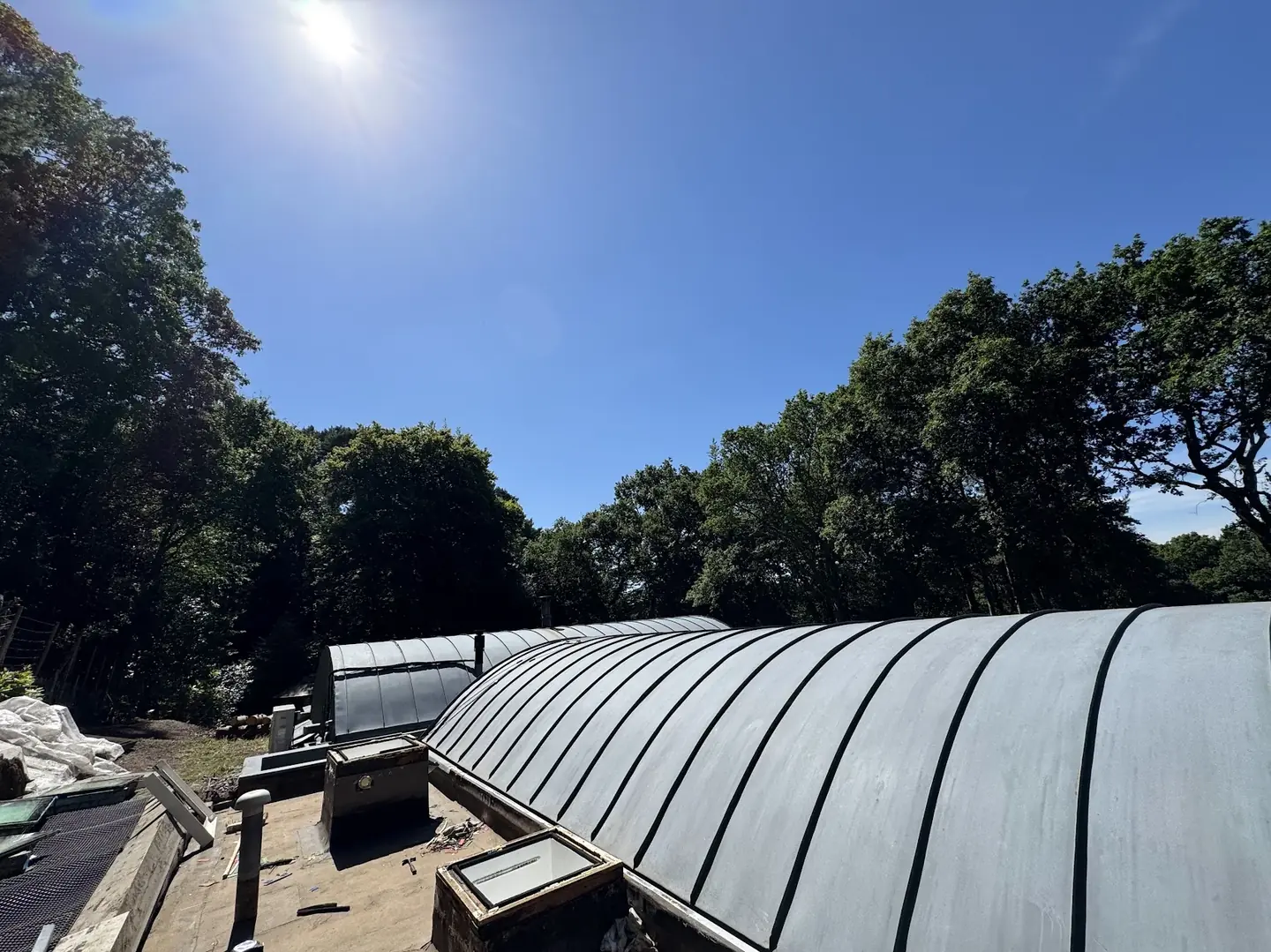
If you've got a flat roof on your extension, garage, porch, or bay window, you've probably already had to deal with a leak at some point. Traditional felt flat roofs have a poor reputation — and often a deserved one. But modern alternatives like GRP (Glass Reinforced Plastic) fibreglass have transformed what's possible with flat roofing. So which is the right choice for your home?
This guide gives you an honest, no-nonsense comparison of the two most common flat roofing options available to Hampshire homeowners in 2025.
What Is GRP Fibreglass Roofing?
GRP stands for Glass Reinforced Plastic — the same material used in boat hulls, water tanks, and car body panels. When applied to a flat roof, it creates a single seamless membrane that's completely waterproof, highly durable, and resistant to foot traffic. It's been the standard for quality flat roofing in the UK for the past 20 years and is now the option recommended by most professional roofers.
GRP is laid as a liquid resin over a specialist deck board, with chopped strand mat worked in to add strength. It then cures to form a hard, smooth surface. A topcoat is applied to finish and protect the surface from UV degradation.
What Is Felt (Torch-On) Flat Roofing?
Traditional felt roofing has been used on UK homes since the mid-20th century. Modern felt systems use a torch-on (also called hot melt or SBS modified bitumen) approach, where layers of bitumen felt are heated with a gas torch and bonded to the deck. A three-layer torch-on system is the minimum for a quality felt installation.
Older cold-applied felt — the type you'll find on many garages built before 2000 — is even less durable and should be replaced rather than patched when it fails.
Side-by-Side Comparison
| Feature | GRP Fibreglass | Felt (Torch-On) |
|---|---|---|
| Typical lifespan | 25–50+ years | 10–20 years |
| Supply & fit cost (avg) | £70–£110 per m² | £40–£70 per m² |
| Seams / join points | None (seamless) | Multiple overlapping joints |
| Maintenance required | Minimal | Regular inspection needed |
| Foot traffic tolerance | Good | Poor |
| Ponding water resistance | Excellent | Fair (joints can fail) |
| UV resistance | Excellent (with topcoat) | Moderate |
| Appearance | Smooth, professional finish | Textured, mineral surface |
Lifespan: GRP Wins by a Clear Margin
A properly installed GRP flat roof should last 25 to 50 years with minimal intervention. Some installations are approaching 40 years old and still performing well. The material doesn't crack, split, or become brittle with age in the way that felt does, and because it's seamless, there are no joints to fail.
By contrast, even a well-installed torch-on felt roof typically needs replacing after 15 to 20 years. The joints between felt sheets are the weakest point — as the material expands and contracts with temperature changes over the years, those seams can lift or crack, and water finds a way in.
Cost: Felt Is Cheaper Upfront, GRP Is Cheaper Long-Term
There's no getting around it: GRP costs more to install than felt. On a typical 20m² garage roof, you might pay £1,400 to £2,200 for felt but £1,600 to £2,800 for GRP. The gap is meaningful, but it needs context.
If a felt roof lasts 15 years and GRP lasts 40, you'll replace felt twice (or more) in the time GRP is still going strong. Add in the disruption, potential water damage repair costs, and repeat labour, and GRP almost always works out significantly cheaper over the life of the roof. It's the classic case of buying once versus buying cheap.
Maintenance: GRP Is Practically Set and Forget
A GRP roof needs almost no maintenance once installed. We recommend a visual inspection every few years — particularly after extreme weather — and a re-topcoat every 10 to 15 years, which is a straightforward job and costs a fraction of a full replacement. That's essentially it.
Felt roofs need more regular attention. You should inspect them annually for blistering, cracking, or lifting seams. Small defects can be repaired relatively easily, but if you leave them, water ingress will spread quickly and the repair bill will grow.
Performance in Hampshire's Weather
Hampshire's climate — damp winters, mild summers, and the occasional coastal storm if you're closer to Portsmouth or Southampton Water — is not particularly kind to flat roofs. The main risks are ponding water during heavy rainfall and UV degradation in summer.
GRP handles both well. Its seamless surface means standing water has nowhere to penetrate, and the UV-stable topcoat prevents surface degradation. Felt can handle normal rainfall fine, but ponding on a flat roof with aging felt joints is a recipe for a leak.
Our Recommendation: GRP for Almost Every Situation
If budget allows, we recommend GRP fibreglass for virtually every flat roof installation or replacement. The additional upfront cost is modest, the lifespan is vastly superior, and the peace of mind of a watertight, maintenance-free roof far outweighs the saving on felt.
The only scenario where felt might be the right choice is if you're on a very tight budget and replacing a flat roof on an outbuilding or structure you don't plan to keep long-term. For your home's extension, porch, or garage, invest in GRP and you won't need to think about it again for decades.
CMW Roofing & Renovations specialises in GRP fibreglass flat roofing across Hampshire. All our GRP installations carry a 15-year workmanship guarantee, and we use proven materials from established UK manufacturers. Find out more about our flat roofing services, or contact us for a free quote.